Phew! We've just finished moving things from the temporary apartment to our new abode. It's been an adventure preparing this new place for living.
Orizaba is a wet place. We're near Pico de Orizaba, which has snow on it even now, and its runoff stokes a river that winds through town. It's the rainy season now, and there have been a lot of tropical storms fueling the clouds. The sky splits open, lightning strikes and makes the lights blink, thunder rolls through the air -- 4 or 5 seconds after the light. The delay surprises us; it seems the lightning is much nearer. Water pours from the sky as from a bucket, usually for about two hours, swelling the river and causing mudslides upstream. We see the results in the river, which looks like a it's full of melted chocolate. (If only!)
All that wet had taken a toll on the walls and plumbing of our new abode. We sanded, spackled, and painted every wall we could reach (some of the ceilings go about 30 feet -- those we half-painted). It looks great!
The plumbing is still problematic. We've replaced the faulty PVC that leads from faucets to drains in two locations, with success. A third still needs replacing, but first we have to figure out how to secure the sink to the wall. It fell off while we were painting, the plaster that had been behind it having dried and fallen away. (A re-reading of our rental contract confirmed what we already thought--that we are on the hook for all these repairs.) But ... after two floodings of the kitchen, we have the water under control (except for the upstairs bathroom. At least we have an alternate.)
Then there is the odor. I won't go into it. Suffice it to say that this must be a result of both aged plumbing and a very wet environment. But, we're getting that under control as well.
Don't let this deter you from coming! It's really quite a cozy home. It just has been an adventure getting it ready. We had two floods in the kitchen before we finally tracked down the right parts and got that system working. And the day the electrician was coming to install light fixtures, we had a flame come shooting out of the kitchen bulb! Thankfully, Angel took it in stride.
So ... no more bare bulbs (except for in the upper hall, where, again, we cannot reach), and a pretty dry interior (except for the utility area, which we'll be working on tomorrow) (oh, and that upstairs bathroom).
Good thing we're young ...
Monday, July 18, 2011


Our Neighbor, George
There is an elderly man living one door down from the temporary apartment we've had in Orizaba, though he spends much of each day outdoors, seated in a plastic chair, watching the townsfolk go by. He is a short man--maybe five-feet tall--although that may be complicated by the sway he appears to have in his right hip, so that his body is slightly S-shaped. His name is George. He is as brown as a nut, except where his eyes have begun to cloud, which makes me imagine that he is slowly setting the world to "fade." And he is as friendly as anyone I've ever known. Although he has a speech impediment--a slur, possibly the result of a stroke--his volume is good, and his greetings always hardy. Of course, combine his speech impediment with our mutual language impediments, and we barely get past, "Hi, how are you?" And "very well, thank you." But we always have a kiss on the cheek, or the hand in his case, and I receive an extra pat on the shoulder when we part. Something makes me think he is a retired priest, living just half a block from his former church, San Juan de Dios. (Come to think of it, that cathedral may have parallel marks of age.) He has been a light for me, here in Orizaba. Where so many things feel a bit strange, his vigil at the porch rail is constant, and his smile and words, warm. One day I had an "aha" moment, realizing who he reminds me of most: Yoda!
Thursday, July 14, 2011
Visiting Cordoba

George and I made the bus trip to Cordoba (about 12 miles) with Nathan, the English Coordinator and my extraordinary boss. Our mission: apply for my FM-3 visa, to allow me to work in Mexico.
Cordoba is a historic town. Originally a Spanish colony, this is also where the treaty ending the Mexican War of Independence was signed. There are many monuments and references to the glorious date of May 21, 1812. The beautiful Municipal Palace has 21 arches; a visual reminder of that date's importance, and a tribute to the citizens of Cordoba who fought so hard for independence from Spain. (I'm sorry I didn't get a good photo of the Municipal Palace's facade.) The mural inside the MP is worth the trip itself!
 The most powerful image in the mural is the prisoner breaking his chains. The one that intrigued me the most shows a beautiful mixed-race woman who escaped imprisonment through magic. She asked the guard for a piece of chalk and drew a magnificent sailing vessel. "What is it missing?" she asked the guard. "Nothing, it is perfect," he said. "No," she said. "It is missing someone to sail it." And she disappeared from the cell.
One of the things I find fascinating about Mexican culture is the mix of orthodoxy and magic woven into society. Many native tribes here were enslaved and horribly damaged, but their cultures also became integrated into the Spanish/Catholic culture--far moreso (in my opinion) than did native cultures in the U.S. (Admitted ignorance of many details, here. I'd love to hear from those of you with further information.)
And the most whimsical piece of the mural is this little guy:

George and I were able to spend a few hours enjoying these sites, as well as a portion of the local museum (image below), while Nathan ran himself ragged getting the documents required for my visa. In classic fashion, he had to return to Orizaba for more paperwork, and we had to then race against the clock ... finally getting approval just AFTER they closed the door for the day. Below is a link to my favorite short movie spoofing the typical process. It's not far from the mark!
Click here for YouTube video.
Tuesday, July 5, 2011
Life Ashore
After six months in La Paz, big changes.
I (Celeste) was volunteering with two charitable organizations--FANLAP (Fundacion Ayudar los Ninos de La Paz) and Care For Kids--but having no good fortune finding a paying teaching job. At last, I received a good offer from a school clear across the country. At first, we didn't even consider it, but then ...
Circumstances combined, and we made the decision to move ashore.
Our budget and our bodies are getting a bit weak for crossing an ocean, and that is what Nereid is built and outfitted to do. We have said goodbye to her, and left her in La Paz. She is on the hard, and listed for sale with La Paz Yachts.
La Paz is a great place to sell a boat, except in the summer. No one wants to go there in the summertime heat! We think it's likely she will sell in the fall.
Meanwhile, we managed to pack and ship ALL our belongings to the mountain town of Orizaba. Orizaba (or Oz, as I affectionately call it) is in the state of Veracruz, near its eastern border. It is very near the third highest mountain in the northern hemisphere, Pico de Orizaba. The climate is temperate. We've arrived for the start of the rainy season ... and find it both refreshing and familiar. Although it's often sunny during most of the days, when it rains, it pours, and reminds us of the Pacific Northwet.
Mimi made the trip with us. Wolfgang's health was failing, and we made the difficult decision to put her down. In hindsight, I may have held on a little long. She was a wonderful companion to me for nearly twenty years. Mimi seems to be happy as the new center of attention. She did remarkably well with the travel, which involved a flight to Mexico City, and a 4-hour bus trip. (It's only a 2-hour bus trip from the city of Veracruz, if you are planning a visit.)
We are installed in a temporary apartment, but last week we found a place to rent for the year. I have signed a contract to teach Middle School and High School English at Centro Educativo Integral de Orizaba (CEICO). The English Coordinator is wonderful, and he has already introduced me to many of the students I will have next year.
And so, we are on the threshold of a new adventure. We will maintain this blog, loosely interpreting the "voyages" so as to include our life ashore.
Buen dia, y Salud!
I (Celeste) was volunteering with two charitable organizations--FANLAP (Fundacion Ayudar los Ninos de La Paz) and Care For Kids--but having no good fortune finding a paying teaching job. At last, I received a good offer from a school clear across the country. At first, we didn't even consider it, but then ...
Circumstances combined, and we made the decision to move ashore.
Our budget and our bodies are getting a bit weak for crossing an ocean, and that is what Nereid is built and outfitted to do. We have said goodbye to her, and left her in La Paz. She is on the hard, and listed for sale with La Paz Yachts.
La Paz is a great place to sell a boat, except in the summer. No one wants to go there in the summertime heat! We think it's likely she will sell in the fall.
Meanwhile, we managed to pack and ship ALL our belongings to the mountain town of Orizaba. Orizaba (or Oz, as I affectionately call it) is in the state of Veracruz, near its eastern border. It is very near the third highest mountain in the northern hemisphere, Pico de Orizaba. The climate is temperate. We've arrived for the start of the rainy season ... and find it both refreshing and familiar. Although it's often sunny during most of the days, when it rains, it pours, and reminds us of the Pacific Northwet.
Mimi made the trip with us. Wolfgang's health was failing, and we made the difficult decision to put her down. In hindsight, I may have held on a little long. She was a wonderful companion to me for nearly twenty years. Mimi seems to be happy as the new center of attention. She did remarkably well with the travel, which involved a flight to Mexico City, and a 4-hour bus trip. (It's only a 2-hour bus trip from the city of Veracruz, if you are planning a visit.)
We are installed in a temporary apartment, but last week we found a place to rent for the year. I have signed a contract to teach Middle School and High School English at Centro Educativo Integral de Orizaba (CEICO). The English Coordinator is wonderful, and he has already introduced me to many of the students I will have next year.
And so, we are on the threshold of a new adventure. We will maintain this blog, loosely interpreting the "voyages" so as to include our life ashore.
Buen dia, y Salud!
Monday, March 28, 2011
Everyday Life in La Paz, Mexico
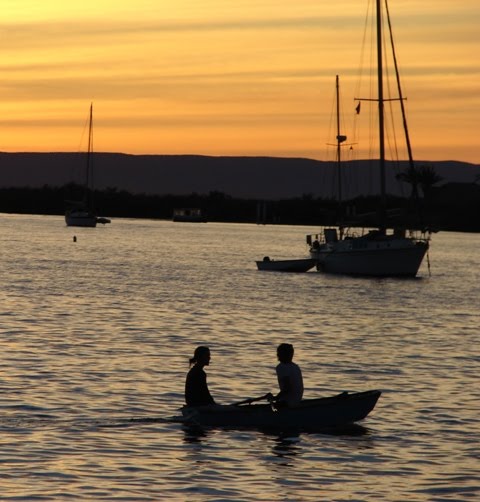
George and I are settling into a pretty quiet routine here in La Paz.
Nereid is anchored near The Magote -- a strip of land extending half-way around the main harbor of La Paz. We have a 5-minute dinghy ride (with outboard motor) to and from the dock at Marina La Paz. George drops me ashore each morning, and I walk to town, glad for the exercise and the time it gives me to listen to "Coffee Break Spanish."
Today, I helped a couple of expatriates from Skagit find their way to a coffee shop with computers and printers, so they could complete their FM-3 visa application process. It's good to have some local knowledge. It always feels good to be able to contribute.
Typically, George spends the day aboard Nereid, where he can use the generator and our cellular modem to write articles on Wagner and reach out to more people interested in his work. I spend the day at coffee shops, plugging into shore electrical and getting a little exposure to local people, in between working on various manuscripts and applying for jobs. Around 5pm I walk back to the dinghy dock, and we have a nice ride back to the anchorage.
The anchorage is pretty quiet, with a few dozen boats spread throughout and dolphins regularly passing through. The daily temperatures on land are in the mid- to high-80's, but the boat is a good 5-10 degrees cooler thanks to the breeze. Nothing special to report - just a day in the life.
Tuesday, December 14, 2010
San Jose del Cabo to Muertos Cove

San Jose to Muertos Cove (23 59.355N, 109 49.352W)
Perhaps it was that we were headed for a place known as "Dead Man's Cove" .... Whatever the reason, we were anxious to arrive before nightfall. At 8:00 a.m. on December 4, we motored to the fuel dock at Puerto San Jose. Alas, a Cayman Island fishing vessel with voluminous tanks had pulled into the fuel dock before us, and there was only room for one! He would be there for another hour. We recalculated the miles left to go and the gallons of diesel aboard our relatively diminutive sloop, and decided to head out.
At 9:00 a.m. we had 8 knots on the nose. At 1:15, 15 knots. At 2:45, 12 knots ... and so it continued. But it wasn't just the wind slowing us down. We had failed to account for two other opposing forces: 1. the outflowing current from the 700-mile long Sea of Cortez, and 2. the pull of a new moon, which one fellow later told us was at peak pulling power for the year. So much for setting anchor before darkness fell.
We made slow progress, and approached Muertos at 10:00 p.m. Our tanks were much lower than we'd anticipated, and the night was as dark as India ink. I have never had so much trouble gauging depth (i.e. distance from the land) and distinguishing the placement of lights (are those anchor lights or lights on land?).
After twenty minutes of careful motoring during which we compared our depth soundings to the chart, we anchored in 40 feet at the coordinates posted above, set the anchor drag alarm for 50 feet and settled in for some sleep. Daylight revealed that we had come far closer to land than we'd hoped to be, and that all those lights I had concluded were land lights were indeed anchor lights. I quietly blessed our conservative choice. Instead of barging in among them, we had bobbed just outside the cove's best shelter ... and ... all's well that ends well, as Shakespeare once argued.
On December 5, we moved Nereid further into the cove and surveyed the shore. To our starboard, a restaurant (reported to be cruiser-friendly); ahead of us a beach; to port, a hotel. Everywhere, the blue, beige, and terra cotta tones of Mexico.
We lowered Galatea over the rail and rowed toward shore, stopping along the way to converse with other cruisers. Some friendly folks from Canada warned us that the wind was forecast to come up hard from the south for the next several days and that it would be best to "stay put" in Muertos until the blow was over. Bobbing alongside their boat, we nodded our heads, probably in rhythm with the swell and having already accepted that mother nature had just reset our agenda.
The day before we had burned through more fuel than budgeted (a sacrifice to current), and heavy headwinds into Cabo would more than deplete our tank. We chatted with them about whether fuel could be gotten ("none known, but someone at the restaurant might know"), refused their kind offer of 5-gallons (the husband had frowned when the wife offered it), then said our goodbyes.
George pulled for shore, where waves broke softly among rows of rocks spaced a panga's width apart. Above the waterline lay a row of pangas, sterns to the cove: these are Mexico's ubiquitous fishing boats, fiberglass work horses about 20-25 feet long, 6 feet wide, and 3-5 feet deep. Here and there among them were men fixing their nets or cleaning a catch, their trucks parked further still upland.
It seemed likely that the section of beach aligned with a panga would be our best bet for a landing without excessive exposure to rocks. I navigated George toward a spot, smiling at the sight of children further down shore who were moving as fast as crabs between the soft foam at the waterline and the shade of their family's beach tent. One of the older women from the tent, elegantly attired in a red dress, walked to the shore and mounted a jet ski. All of the children began jumping and shrieking in glee. She helped one of the children into a life jacket and sat him in front of her, then took off with a roar, her long black hair streaming out behind them. She looked like the coolest grandma ever!
We landed Galatea with aplomb (and a splash) and made our way upland, chatting with a couple of fishermen and patting a black dog who stood in the shade licking the remains of a freshly cleaned dorado. "Do you know where we might find fuel around here?"
"How much do you need?"
"15 gallons."
"Go get your cans. I'll drive you."
God had just shown up in the form of a retired commercial fisherman named Terry.
Thursday, December 2, 2010
San Jose del Cabo

We have traveled a long way in the past week or so, and we're feeling just about every nautical mile! But, we're now tied up at a marina in San Jose del Cabo, soaking in the luxuries of hot showers, a full water tank, and internet access. There's an art walk in town tonight, and we intend to hike a mile to see it.
After leaving Bahia Tortuga we sailed south under genoa and a double-reefed main. Shifting tailwinds made it difficult to avoid an accidental jibe, so we sheeted in the genoa and let out the boom. Unfortunately, we heard a CRACK and saw something go flying. That was the scariest moment I've had on Nereid. Fortunately, it wasn't the mast or the boom: it was the shackle that held our preventer's block to the starboard toerail. George made a trip out to the foredeck, picked up the hardware and tied down the mainsail. He brought back into the cockpit another piece of hardware; one we hadn't realized had come loose. We believe it's a piece that helps keep the mainsail in its track. So that was the last of our using the main sail on this section of travel. We kept on under genoa as long as it was useful, but motored through the night.
In the wee hours we motored past the Isle of Cedros, rocking and rolling in heavy seas. Visibility was limited due to salt spray, and so we rolled up the side panels to look directly out into the night. Orion was laying on his back on the horizon, larger than I have ever seen the constellation. We watched him travel over a third of the dark dome, and switched shifts. I saw what looked like a brightly lit boat not far off our port side beam and called George back up to identify her: it was the half moon, rising behind the clouds, low to the water and orange enough to be a pumpkin. For the next couple of hours, we motored through heavy seas, wind and spray paying friendly visits as we worked around to the backside of the island, where a nice anchorage provides shelter for folks like us. There were about eight other cruisers anchored when we arrived, but plenty of room. We set our hook in forty feet around 2:30 a.m., ready and grateful for bed.
Our next stop was Puerto San Carlos. It's not a recommended stop for cruisers, but we needed fuel (now that we knew we'd be motoring) so we worked our way through the tricky channel and arrived at the fishing pier about an hour before sunset. It's a real working dock, and it took us awhile to find a place we thought we could tie up without subjecting Nereid to rusty shrimp boats and pilings. Fortunately, some fishermen on the dock offered a hand and some oversize bumpers. We fueled up, and practiced our Spanish, and then accepted a ride into town to get fresh fruits, vegetables and tortillas. Puerto San Carlos is a tiny town with unpaved streets, except two, and the same fine dust that we experienced in Bahia Tortuga. Thanks to the kindness of strangers, we were back on the boat freshly provisioned and fully fueled before sunset. We motored a few hundred yards out and dropped anchor. It was a peaceful night.
The next morning we repeated the gauntlet, motoring out through the narrow channel that leads into Puerto San Carlos. We hit open ocean around 9:30 a.m., knowing we had a long stretch before us but wanting to time our trip around Cape Falso for the calmest time of day. Around 11:00 a.m., I saw what I thought might be a dead seal off the port bow. It's not unusual to see seals sunning themselves on the surface, but this one was unusually stationery. I didn't wake George, since I thought it might be a sad sight; but when I got nearer I saw that it was actually a turtle! I woke George, and over the course of the next mile we saw several of them. What a treat! It was invigorating to see them alive and wild.
The remainder of the voyage was simple and required, simply, endurance. We crossed the Tropic of Cancer and enjoyed a grail moon. (In the north we only get it at Easter, but this was indeed a grail moon, looking like a chalice.) Sunrise was welcome, as it always is, and soon enough we saw the Cape ahead and began picking up chatter from the fishing vessels that call Cabo San Lucas their home port. We rounded Cape Falso a little before noon, impressed with the rocks, cliffs and sand and in no way worried about the currents. From then on, it was simply sightseeing - marveling at the developments along the shore, the size of the cruise ships, the number of parasails. Around 2:30 p.m. we radioed Puerto San Jose del Cabo's marina and negotiated a slip for two nights. And so ... here we are. Safe, sound and salty.
Subscribe to:
Posts (Atom)


 Posts
Posts


